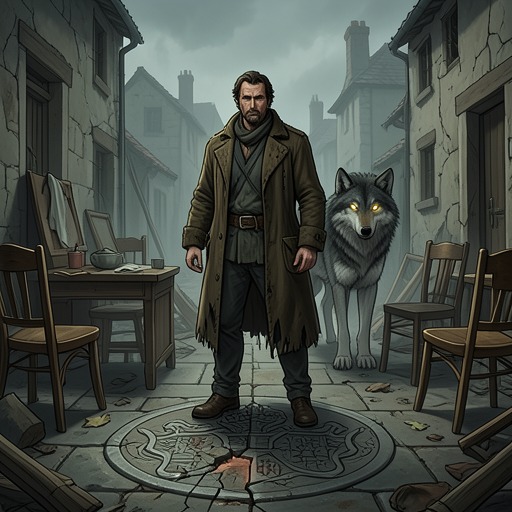
Limousin
The Best Werewolf Short Stories 1800-1849Limousin is presented as a dangerous, densely wooded region of ancient Poictou where the landscape, local memory, and communal fear combine to produce one of the book’s defining werewolf settings. Its forests shelter fugitives and hunters, but they also become the supposed home of Wehr-Wolves whose nocturnal howlings, attacks, and transformations turn a rural province into a theatre of superstition, persecution, vengeance, and tragic recognition.
Definition and Legendary Setting
Limousin is identified with the hilly and wooded district of Upper Limousin, the southern division of Upper Vienne in the ancient province of Poictou. The region has long been celebrated in romance as a haunt of creatures suspended between phantom and beast of prey. German tradition calls them Wehr-Wolves, while French usage supplies the names Bisclavarets and Loups Garoux; the English account calls them Wild Wolves. The local belief is that these beings are human men in compact with the Arch Enemy, able at certain periods to assume both the form and nature of wolves.
The werewolves are imagined as leaving their own hills and mountains at midnight and running howling through the silent streets of nearby towns and villages. Their visitations terrify the inhabitants, yet they also intensify popular piety, making supernatural fear and religious response inseparable. Limousin therefore functions not merely as a backdrop for monstrous action: it is a cultural geography in which the forest is treated as the border of ordinary human life and the night as the time when that border fails.
Refuge, Exile, and Return
Gaspar de Marcanville enters Limousin after years of exile in the Hanoverian Harz. Having been betrayed and falsely disgraced by the Count de Saintefleur, Gaspar has spent years in the forest with Rosalie de Marcanville and their daughter Adéle de Marcanville. He prepares a written account of the treachery, supported by a certificate from his confessor, Father Ægidius, so that the document may reach the King if Gaspar dies while trying to provide for his family.
Gaspar becomes an accomplished hunter in the harsh woodland retirement. His need to preserve Rosalie and Adéle keeps him alive: the wild buck cannot escape his spear, and the bear is too weak to resist his attacks. After Rosalie dies, roughly ten years into the exile, Gaspar resolves to return to France and seek an Ordeal of Combat with the Count de Saintefleur. When he reaches the wooded Upper Limousin, however, he abandons the direct approach to the Court. The forest has altered him so completely that he believes he can remain unknown in France, live as a hunter, support Adéle, and leave her closer to the King if he should die.
For that reason Gaspar uses part of his remaining property to secure a residence in a dilapidated chateau near St. Yrieux. Limousin thus becomes both a substitute homeland and a suspended state of exile. It allows Gaspar to return physically to France without recovering his social identity, while placing his private struggle inside a landscape already prepared by legend to interpret him as something other than a dispossessed nobleman.
The Werewolf Panic
After Gaspar and Adéle arrive, St. Yrieux is alarmed by reports that a Wehr-Wolf, or perhaps a troop of them, inhabits the Limousin woods. Terrific howlings sound at night, and the rush of a chase passes through deserted streets. The townspeople respond not by confronting the creatures with weapons, torches, or a united search, but by fastening their windows more securely, abandoning those already attacked, and offering brief expressions of pity before protecting themselves.
The danger appears concrete as well as legendary. Country people living nearest the forests are said to have lost their children, and the lacerated remains later found in the woods seem to indicate that an abandoned Wehr-Wolf has preyed upon them. In a town where many people are unemployed and gossip is a central form of social life, the attacks become an event of collective importance. Residents repeatedly gather at the Chevalier Bayard’s Arms, ostensibly for mutual protection, while recounting increasingly unreliable stories until fear prevents them from separating for the night. The inn, Nicole Bonvarlet’s wine, and blazing fagots become a temporary human enclosure against the forest.
The panic also shows how Limousin converts uncertainty into communal certainty. Dr. Antoine Du Pilon discusses the creatures through an accumulation of learned authorities, and anyone who suggests that the Wehr-Wolves are merely ordinary wolves risks the hostility of listeners already convinced by repetition. The forest’s physical distance from the town does not contain its influence; the woods enter the inn through rumor, theological speculation, and the inhabitants’ defensive rituals.
The Forest Chase and Gaspar’s End
A stranger arriving at the inn reports that the King is travelling through Limousin. While riding ahead with two attendants, he became separated in the darkness and was attacked by an enormous Wolf with fiery eyes and terrifying howlings. The animal rushed at him with extraordinary speed. After the encounter, his horse dragged him through the briars while what seemed like a troop of a thousand wolves howled behind him; the horse finally collapsed at the forest’s edge, leaving him weak and wounded to reach the town.
The stranger’s account brings the royal journey, the frightened town, and the forest into a single line of action. The townspeople prepare torches and assistance to meet the King, but the missing wolf’s paw becomes an important clue. The wounded stranger is the Count de Saintefleur, Gaspar’s ancient enemy, and his arrival in Limousin makes the forest the place where an old political betrayal is forced into direct confrontation.
Adéle tends the injured Count, who reveals his identity and insists that the time of vengeance has arrived. Before the conflict can be resolved through human testimony or formal combat, a large Wolf wounded by the loss of a forepaw leaps upon him and kills him. At that moment the royal train arrives with flambeaux. A Knight strikes the Wolf with a large partizan; Adéle tries unsuccessfully to save the animal, but the blow destroys both Wolf and human form. The creature falls backward as a tall, gaunt man in hunter’s dress: Gaspar de Marcanville, revealed as the Wehr-Wolf of Limousin. Adéle offers the King the packet hidden in her bosom and then collapses upon her father’s body.
Narrative Significance
Limousin gathers the book’s recurring tensions between real animals and supernatural interpretation. Wolves are capable of entering settlements, attacking livestock or people, and behaving according to hunger and pursuit; older werewolf lore, meanwhile, explains such violence through sorcery, demonic compacts, and human transformation. The tradition that a wolf which has tasted human flesh prefers it thereafter helps explain why actual predation could become the seed of a more fearful belief. In Limousin, that belief is not abstract history: it governs where people walk, how they secure their homes, what they repeat in public, and whom they condemn.
The region also recalls earlier werewolf traditions elsewhere in the book. The Ashford churchyard and Wolf’s Cross are made into supposed nocturnal haunts, while accusations against Francoise Thilouze arise when powerful people encourage the rumor that she changes into a wolf. Limousin extends that pattern from local suspicion to an apparently confirmed transformation. Its forest is at once refuge, hunting ground, courtroom, and execution place. Gaspar’s final change does not simply validate the townspeople’s stories; it reveals how a persecuted and displaced human history has been absorbed into the legend surrounding the land.
As the setting of The Wehr-Wolf: A Legend of the Limousin, the region marks an important stage in the literary development of the werewolf short story. The wider history of the monster moves from superstition and folklore through poetry toward nineteenth-century short fiction, and Limousin provides a concentrated example of that transition. The landscape preserves ancient names and fears, but the narrative gives the werewolf a personal history, a political enemy, a daughter, and documentary evidence of injustice. Its final image is therefore deliberately double: the forest monster dies beneath royal lights, while the hunter’s human identity appears only at the instant of death.